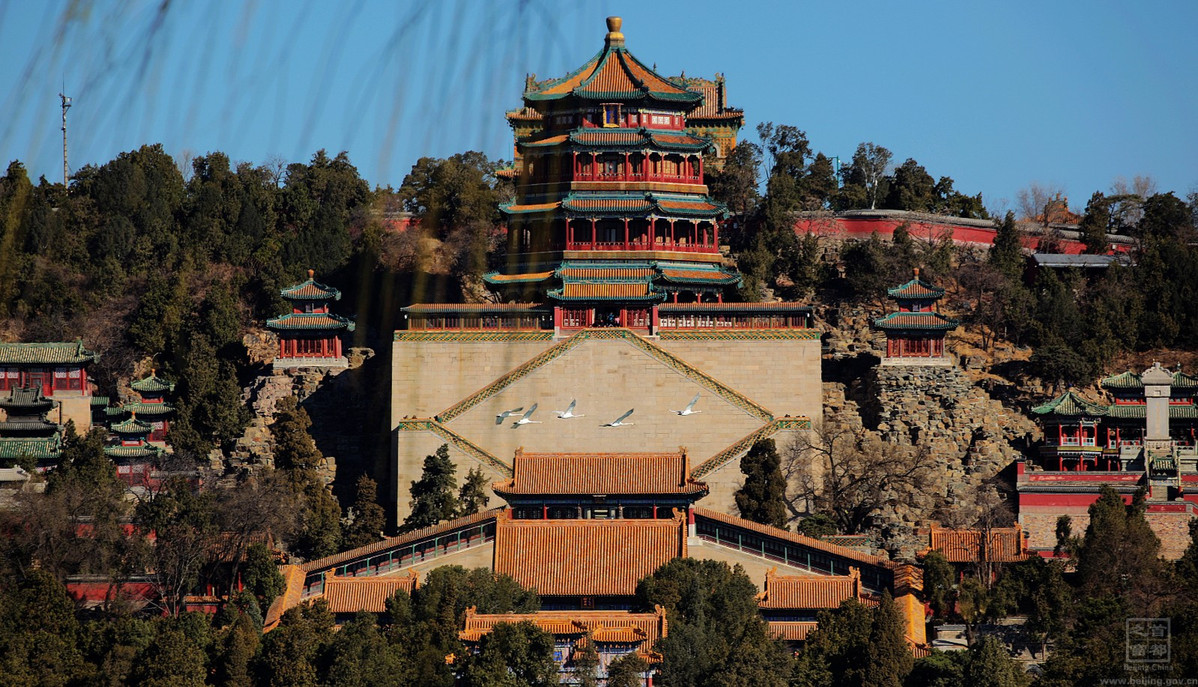
Summer Palace
Introduction
The Summer Palace, is a renowned imperial garden from the Qing Dynasty (1644-1911) in Beijing. It exemplifies the profound integration of natural landscapes with architectural grandeur, embodying the quintessential Chinese gardening philosophy of creating a garden as if it was naturally formed. The garden spans a vast area of around 3.08 square kilometers, with Kunming Lake making up approximately three-quarters of this space.
The natural beauty of the lake, combined with the surrounding hills, provides a breathtaking backdrop for the garden's historical architecture, which is dispersed across the Hill of Myriad Longevity and several man-made islands. The Summer Palace is a reflection of the art and culture of its time, offering a glimpse into the lifestyle and aesthetics of the imperial court.
History
Construction
The construction of the Summer Palace began in 1750 during the Qianlong Emperor's reign in the Qing Dynasty. Originally evolved from the Garden of Clear Ripples (Qingyi yuan), the palace was intended to serve as a luxurious retreat for the imperial family. The design incorporated Kunming Lake, a natural body of water, which was expanded to its current size under the Qianlong Emperor's directives. The lake was designed to reflect the traditional Chinese gardening practice known as "one pool containing three fairy isles", and three islands were constructed within the lake to embody this ideal. The garden's layout and features exhibit the opulence and cultural sophistication of the Qing Dynasty, blending nature with human-made aesthetics.
Development over Dynasties
Throughout its history, the Summer Palace has undergone significant transformations. After its initial construction, the garden suffered substantial damage during the Second Opium War in 1860, when it was burned by Anglo-French coalition troops. The garden was left in ruins until 1886 when the Qing government, led by Empress Dowager Cixi, mandated its restoration using funds appropriated from the navy. This restoration was intended to transform the Summer Palace into her residence following her retirement as the de facto ruler of China. It was during this period that the garden was renamed as the Garden of the Preservation of Harmony.
The garden faced another wave of destruction in 1900 during the invasion of the Eight-Nation Alliance, leading to further renovations in 1902. These renovations, along with subsequent restorations following the establishment of the People's Republic of China in 1949, have helped preserve and restore many of the key scenic areas within the garden, such as the Four Great Regions, Suzhou Street, and various iconic halls and towers.
Restoration
The restoration of the Summer Palace has been an ongoing process aimed at preserving its historical significance and architectural integrity. The major restoration efforts commenced in the late 19th century under the orders of Empress Dowager Cixi, who sought to restore the garden to its former glory after the devastations it had suffered. These efforts continued into the 20th century, particularly after the establishment of the People's Republic of China, which initiated numerous projects to repair and maintain the garden's structures and landscapes. Key areas of the garden have been meticulously restored to reflect their historical authenticity, allowing visitors to experience the grandeur of the imperial garden as it was originally intended.
Architecture
Layout
The layout of the Summer Palace is a masterful blend of natural and human-made features, designed to create a harmonious and serene environment. Kunming Lake, a central element of the garden, covers a significant portion of the area and serves as a focal point around which the garden's structures and landscapes are arranged. The lake is complemented by the Hill of Myriad Longevity, which provides a natural elevation and a vantage point for viewing the surrounding scenery. The garden's architecture is strategically placed to enhance the aesthetic appeal of the landscape, with pathways, bridges, and numerous historical structures seamlessly integrated into the natural environment.
Notable Structures
The Summer Palace is home to several notable structures that exemplify the architectural and cultural achievements of the Qing Dynasty.
Seventeen-Arch Bridge: Built in 1750, this bridge is the longest in Chinese imperial gardens, stretching 150 meters and adorned with over 500 stone lions in various postures. The bridge connects one of the isles in Kunming Lake to the east bank, and its design is considered a masterpiece of Qing stone carvings.
Tower of Buddhist Fragrance (Foxiang ge): This three-storey, octagonal building stands 36.44 meters high and is a highlight of the garden. It houses a gilded statue of the standing 1000-armed Avalokitesvara and offers a stunning view of the surrounding area.
The Stone Boat: Completed in 1755, this 36-meter long structure is made from large stone blocks and was initially built with a traditional wooden cabin, later replaced with one in a Western style in 1893.
Sea of Wisdom (Zhihui hai): Commissioned by the Qianlong Emperor, this religious sanctuary is constructed of brick and stone, featuring glazed tiles and numerous Buddhist statues. Despite damage during invasions, it remains a significant spiritual site within the garden.
Garden of Harmonious Pleasures (Xiequ yuan): Modeled after a famous garden in Wuxi, this area features covered corridors, twisting pathways, and interconnected towers and pavilions surrounding a large pond, providing a continuously changing scenic experience.
Cultural Significance
The Summer Palace holds immense cultural significance as a testament to the artistic and architectural prowess of the Qing Dynasty. It is a symbol of the imperial power and sophistication of the time, reflecting the intricate balance between man-made structures and natural landscapes that is central to Chinese garden design. The garden's ability to integrate diverse architectural styles and cultural elements makes it a unique representation of Chinese culture and history. Today, the Summer Palace serves not only as a historical site and tourist attraction but also as a cultural treasure embodying the rich heritage and aesthetic values of China's past.








